Research > Interviews >
Working with support people and caregivers
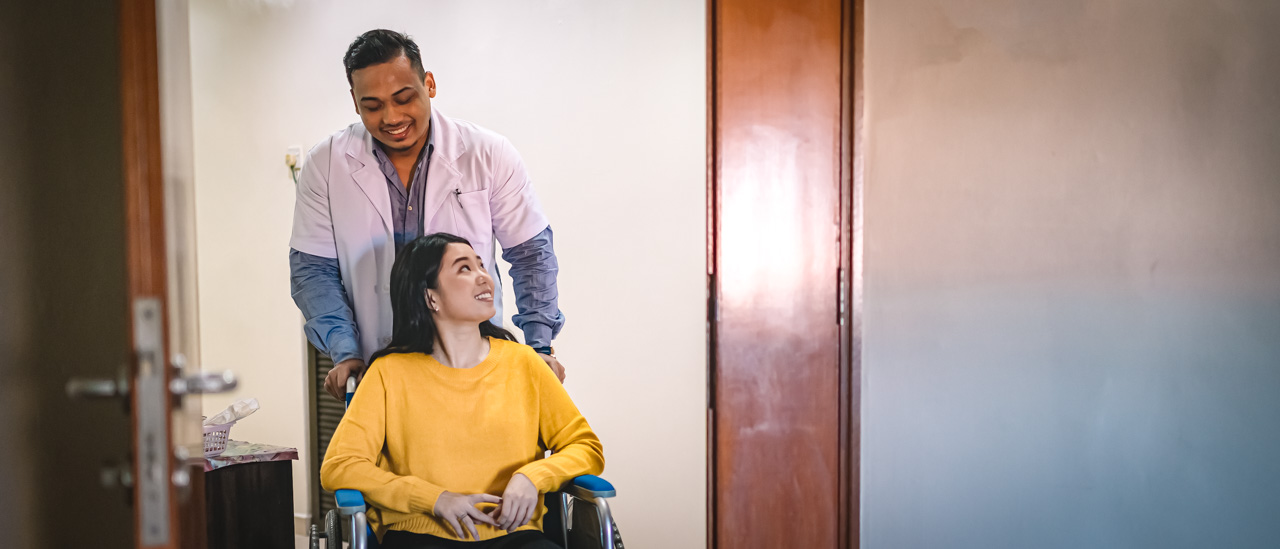
Many disabled people rely on family and/or professional caregivers to make sure their basic needs — such as eating, toileting, dressing and communication — are met. It’s important to recognize that it may be appropriate for a disabled person who is a source to use a support person for any number of reasons and that doing so does not necessarily speak to their competence as a source to be interviewed.
For interviews, be open to having a support person in the room if your disabled source asks for such an accommodation, but do not ask the support person to participate in the interview unless that’s part of the story from the beginning (such as in a piece about the relationship between the disabled person and the support person). If you’re interested, you can always go back to the support person later for their take.
But disabled people don’t always have or need “helpers” with them every time they enter a public space. And it’s not appropriate to assume that a support person or someone there to provide care in another way is “in charge” of a disabled person or “in charge” of the interview. Without actually doing some investigation, you shouldn’t assume the support person needs to be part of the story. You definitely shouldn’t assume that the support person can or should speak for a disabled adult. (I assume adult sources here; for interviewing legal minors, there are excellent resources available to journalists on interviewing children that apply just as much to disabled children.)
Always speak directly to the source, regardless of their support needs and any people around the source. Do not address an attendant, support person, family member or friend instead of a disabled person. For example, do not ask “Can she do X?” when she is sitting right there. Feel free, though, to introduce yourself to the support person if your source does not introduce you — some of us with disabilities are so used to having caregivers come in and out of our space all day that we forget to do introductions. Follow the disabled person’s lead on how much to include the support person in the interview — but keep in mind, for example, that if you wish to feature a support person in your story, you must identify yourself as a journalist and ask the support person for their consent to record, just as you would with any other source.
In the interview of your disabled source, do not look to support people for confirmation of what the disabled person says. There is no need to speak to a support person afterward to “debrief” or check the veracity of the interview, unless this is something the disabled source has requested or unless the support person is a character in the story in their own right. (In that case, think carefully about balance; ask yourself why you as a journalist need to speak to the support person alone but not the disabled person.)
Sometimes, however, the disabled person’s caregiver will be in the room, and depending on the situation, the disabled person may have little to no control over whether and when they show up. Do not assume you know whether a caregiver is professional staff or an informal caregiver, such as a family member or friend. And do not assume by the type of care you see done how well a disabled person knows the caregiver. Sometimes, the person providing extremely intimate care could be someone the disabled source has just met. Sometimes, family members or friends learn how to do caregiving activities that theoretically “should” be done only by professional caregivers, such as suctioning the lungs, because there’s a shortage of qualified caregivers, and their loved one needs to be able to breathe. (There is always a shortage of caregivers.)
Conversely, if someone has professional caregivers, that doesn’t necessarily mean the disabled person is not close with those caregivers. The relationship between care providers and care recipients can be startlingly intimate: when you see each other almost every day, for years, in vulnerable positions, you can become part of an extended surrogate family. If you’re investigating the death of a disabled person and you want to know what was going on in their life before their death, their longtime caregiver is probably your best source.
TVO is a registered charity #85985 0232 RR0001
Visit our other websites:
TVO.me • TVO Today • TVO Learn • TVO ILC • TVOkids
Copyright © 2026 The Ontario Educational Communications Authority (TVO)
Terms of Use • Privacy Policy • Copyright