Building disability-friendly newsrooms
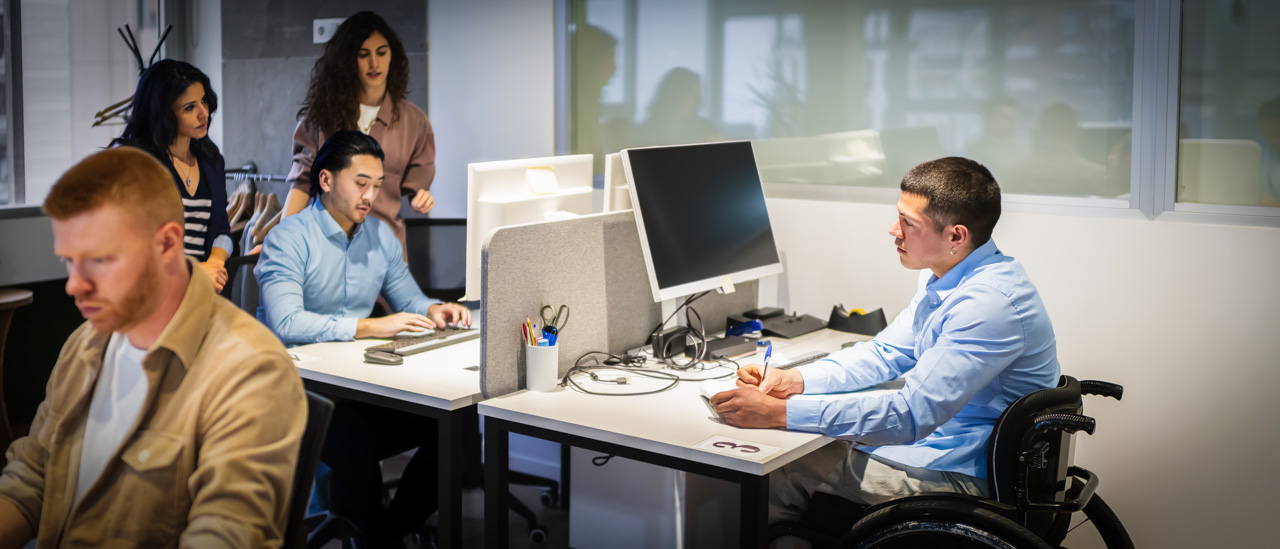
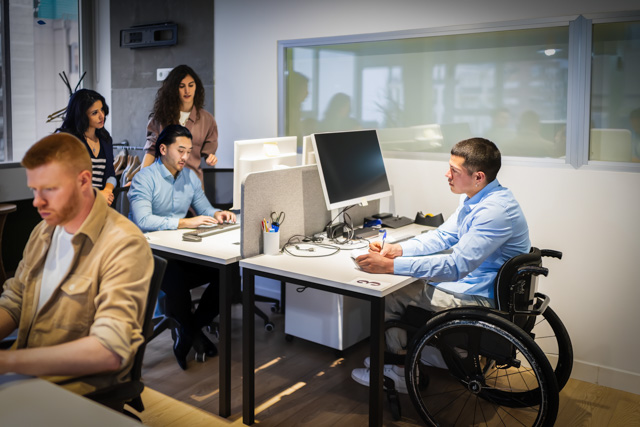
The most important thing we journalists and other media professionals can do to advance our disability coverage is to hire disabled journalists and support their careers.
You’ll notice I said we should hire disabled journalists — not just publish them. Regardless, you should definitely pay them rather than offering them “exposure.” Beth A. Haller writes that disabled journalist Helen Keller submitted a piece to a newspaper and the editor wrote her a note in response, calling her an “angel” and talking about how much hope Keller inspired in other people just by existing[1]. The editor concluded by saying that, of course, he could not pay Keller for her work. This anecdote will resonate with many disabled journalists who have tried to sell freelance work.
Many disabled journalists struggle to find employment because of so-called resumé gaps: It is more difficult for us to find jobs. We’re more likely to have periods of unemployment that last longer than the norm, whether that’s due to health problems cropping up, precarious employment or being the first to be let go when layoffs come. Many journalism jobs take place in inaccessible newsrooms, and requirements such as having a valid driver’s licence exclude many who would otherwise be qualified. A good number of employers are not familiar with the duty to accommodate or do not realize that they can, in fact, accommodate disabled journalists. Disability-related health needs can make it harder to apply for jobs that are available as it is more difficult to move to different cities or towns when you have disabilities that require specialist care or a sustained relationship with the same family doctor. Let’s not even get into the paucity of accessible housing in this country.
Building disability-friendly newsrooms will require taking some of these barriers into account and realizing that perhaps they are not as insurmountable as they may seem at first glance. Funding exists to help employers institute accommodations without experiencing undue hardship. Jobs can be redistributed or reimagined so that disabled people can do work that their disabilities and their talents allow them to do, without running into barriers. Many renovations are easier than they first appear. I’ve noticed that many employers, while not necessarily intending overt discrimination, like to put things in their job description that forestall certain accommodation decisions. Certainly, some jobs, such as that of a camera-person, might require a person to be able to lift 50 pounds (about 23 kilograms), but does that mean every journalism job in a newsroom should have that same requirement? Employers worry about the costs of accommodations — and they may seem daunting up front — but people rarely talk about the cost of not accommodating disabled journalists.
And we’ve seen these costs: worse coverage of health, the justice system, education, challenges facing older adults and many other beats that everyone would agree are of importance to the public. Not including disabled people in your newsroom means you’re missing out on a significant portion of people in Canada (at least 27 percent, as of 2022), people who have unique and different perspectives on the world and are used to making logistical decisions, working hard to address sudden obstacles thrown in their path, collaborating with others and being adaptable.
Keep in mind, though, that the articles that circulate now and again touting the “business case” for hiring disabled people can themselves be concerning. Hiring disabled people is considered a good investment because, apparently, disabled people are more likely to be considered loyal employees — that is, we are more likely to stay in a job once we have it, because we are afraid we won’t be able to find another one. (This is very much saying the quiet part out loud.) What I want to see is a world in which disabled journalists know that, whatever happens, they’ll be able to find a place for their talents.
Such “business cases” also usually mention that disabled people are known to take fewer sick days than other employees do, because we are afraid that taking sick days will cause our employers to judge us harshly or consider us incapable. Disabled journalists and other disabled people should, of course, feel free to take as many sick days as they need and as they’re entitled to through their employment contract. If a disabled person takes sick days, that doesn’t mean they’re unreliable. A disabled person being sick, whether that sickness is something run of the mill, which anyone could get, or whether it’s related to their disability, should not invite a referendum on disabled people as a class of employees.
I’m not suggesting that disabled people should cover disability or make it their primary beat — but if disabled journalists want to, our experiences can help. In her time, Keller used her fame and status as an inspirational “angel” to speak about the taboo topic of syphilis causing Deafblindness in infants, as it had done in her own case. Keller’s advocacy saved the vision and hearing of many infants, and her writing led to a policy change: every infant born would get a solution of silver nitrate in their eyes to stop the damage from congenital syphilis.
More recently, disabled journalist Sara Luterman looked into then-US congressman Madison Cawthorn’s claims that he’d been a Paralympic athlete or trained for the 2020 Paralympic Games. Luterman could find no record of Cawthorn making a concerted effort to train or competing at any level[2]. No other reporter had ever subjected Cawthorn’s claims to scrutiny before.
As Luterman herself has pointed out, doing this work did not require investigative chops beyond those involved in standard reporting. It’s easy to figure out who has competed in the actual Paralympics; the data is posted publicly, and the events are televised. The issue was that nobody had ever bothered to fact-check Cawthorn’s assertions — it took a disabled journalist to ask whether what he was saying was true, speak with disabled athletes, and speak with those involved in the Paralympic Games.
Disabled journalists have contacts and are aware of context in the disabled community simply because we live our lives as part of it. That perspective as part of a community is valuable — not just because it supports some abstract idea of diversity or inclusion, but also because it allows the journalistic profession to tell more varied and true stories.
SOURCES
- For Helen Keller, see People of Interest and see Beth A. Haller, Byline of Hope: Collected Newspaper and Magazine Writing of Helen Keller (Advocado Press, 2015).
- See Sara Luterman, “The Ignominious Deceits of Congressman Cawthorn,” The Nation, January 22, 2021, https://www.thenation.com/article/politics/madison-cawthorn-paralympics/.
PUBLICATION MENU
TVO is a registered charity #85985 0232 RR0001
Visit our other websites:
TVO.me  • TVO Today • TVO Learn • TVO ILC • TVOkids
Copyright © 2026 The Ontario Educational Communications Authority (TVO)
Terms of Use • Privacy Policy • Copyright