
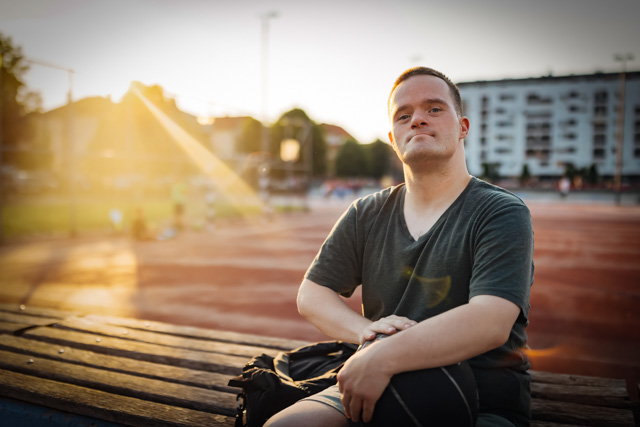
Framing >
Common frames to avoid
Given those models, what are common pitfalls for journalism? In this section, we look at common frames to avoid, but later sections of this style guide also consider problematic language, tropes and narratives.
Frame to avoid: Disabled people as helpless/hopeless victims
I’m the first to say that things aren’t great for disabled people in Canada. The statistics I shared in the introduction are grim, and the laws in place to enforce the rights of disabled people often don’t have adequate or accessible enforcement mechanisms. Services to disabled people seem to be the first to be cut and the last to be expanded, and the areas where there has been some progress often are the ones that affect wealthy and well-connected disabled people. (I’m thinking of the minimal COVID-19 aid offered to disabled people by the federal government; only those who’d claimed the Disability Tax Credit in the previous year were eligible. Many poor disabled people, who needed help most, couldn’t qualify despite desperate advocacy, whereas I, who had a full-time job at the time, got the aid automatically deposited into my bank account without even having to ask.)
All that being said, with the exception of the newly disabled, most disabled people rate their quality of life as identical to that of people without disabilities[1]. Those who do acquire disabilities, after an initial period of depression and anger, often adjust and go on to lives that they think are as good as or even better than before. Even those who do wish to be cured often say that they wouldn’t go back to a world in which they had never been disabled because they see value in the experiences they’ve had or the people they’ve met. While disabled life certainly has its challenges and frustrations, it also has joys and strengths that are unique to it and can bring with it resilience and patience. (My disabled friends and I were bemused by the absolute existential crisis some people went into when the first COVID-19 stay-at-home orders came into effect in 2020 and they couldn’t go places at will for a time. It was as though not being able to have a few mediocre brunches was a threat to their core selves, on par with actually dying of COVID-19. If I felt that not being able to go to every single restaurant whenever I liked was such a traumatic violation, I would simply cease to function.)
Snark aside, assuming disabled people’s lives must be miserable and without hope — and reflecting that in our coverage — actually causes harm. Studies have shown that disabled people receive worse medical care because of inaccurate perceptions about our quality of life[2]. The difficulties that disabled people do face in life often aren’t prioritized by medical research. Stories about disabled people and physician-assisted dying rarely face scrutiny — for example, to ask if there are other factors in a disabled person’s life that might be contributing to their wish to die, as in the case of Jerika Bolen — because being disabled is seen by some as enough reason to pursue that assistance[3]. Stories in which caregivers murder disabled people (something that’s common) are frequently framed as the murderer wanting to end suffering, and the murderers themselves tend to get sympathetic treatment by the media, as though having to give care to a disabled person is horrible enough to justify murder all on its own [4]. We need to stop this.
Frame to avoid: Disabled people as perpetual children
I’m not sure how to explain why this is bad, other than to say that it just isn’t true. No, it’s not true of any disabled people. Not people with Down syndrome. Not autistic people. Not people with any developmental disability or any other disability (see Glossary). Although sometimes cognitive capacity is limited, and some disabled adults require more assistance with the tasks of adult life than do non-disabled adults — in some cases, for example, they require a guardian to make legal decisions on their behalf — disabled adults remain adults. Framing disabled adults as children does not reflect the reality of living in an adult body (to this point, disabled adults with intellectual impairments still go through puberty, with all that implies), it robs them of agency, and it ignores the harm that can be done to and by them. The extremely common idea that disabled people are asexual means that sexual abuse is often missed or rejected as unthinkable. However, this common idea of disabled people as asexual, perpetual children does put disabled people in danger of being dismissed when they are hurt, assaulted or victimized in any other way, which is far more likely to happen to them than to non-disabled age peers.
Framing disabled adults as perpetual children also undermines the right to self-determination and is used as justification for going against the wishes of disabled adults on the grounds that disabled adults cannot know any better. Although there are times when the state or some other authority must intervene to protect the lives and safety of disabled adults against their will, going too far with this paternalism — and covering it in the media approvingly — can justify horrific abuse, exploitation and the deprivation of liberty.
We have seen this play out in the case of Britney Spears, whose father, Jamie, acted to put her under conservatorship in 2008, after her erratic behaviour caused worldwide concern. For a long time, Jamie was hailed as a hero for protecting his daughter and getting Spears to a place of stability, but many of the musician’s fans knew something wasn’t right. For years, those fans struggled to get media attention, but it wasn’t until a 2021 investigation by Ronan Farrow and Jia Tolentino of The New Yorker that there was enough pressure to get the matter back before the judge [5]. When Spears was allowed to speak for herself in court, she made it very clear that, for her, the conservatorship was a prison: her father had forced her to perform against her will, which made millions, while she had to ask permission to buy as much as a cup of coffee. Jamie controlled where Spears went, whom she saw, and whom she could speak to on the phone. Spears was prevented from marrying, and birth control was forced on her — that is, an IUD was inserted against her will. Spears was eventually freed from conservatorship, but many people never are. (Also note who is the centre of this story and how they are named. See Language.) Those who do require some form of guardianship are often exploited. (The 2020 thriller movie I Care a Lot was inspired by a real-life phenomenon: professional guardians, who are granted power of attorney over elderly people and then sell their assets, ostensibly in the elderly person’s best interests — but those guardians also turn a profit).
Frame to avoid: Disabled people as fakers, malingerers, frauds or “scroungers”
In her book Crippled: Austerity and the Demonization of Disabled People, disabled journalist Frances Ryan traces how the media framing of disabled people in Britain primed the public to accept truly horrifying “austerity measures”: disabled people who led active and fulfilling lives saw support from government programs cut to the bone or destroyed altogether[4]. The British government contracted out the administration of disability benefits and pensions to private firms, which resulted in hundreds of thousands of people losing their benefits. The companies, such as Atos, operated under a quota system that incentivized cutting off benefits for as many people as possible. This led to truly horrific situations, such as a person with terminal cancer and a couple of months to live being declared “fit for work,” or people losing their benefits because they had no way to travel to their assessments, which weren’t accessible to them. Draconian work requirements, such as those that require people to accept jobs they could not physically do or get to, are another reason people lost their benefits[6].
One would expect there to be a public outcry, and in a sense, there was, but the government avoided much of the scrutiny and outrage it would otherwise have received by blaming disabled “scroungers” for other austerity measures. It encouraged anger directed at disabled people by saying that they were a drain on the public purse and that some people who could work chose not to[7]. Think that can’t happen here? Think again.
None of this is to suggest that we journalists should not evaluate disabled sources’ credibility or claims with our usual rigour; we should use the same level of care with all sources. But treating disabled people’s claims as less credible by default sets us up for so many problems.
Frame to avoid: Disabled people as inspiration porn
I can’t explain inspiration porn better than the late, great Stella Young did, so take a second to watch the video or read the transcript[8]. If you don’t have the time to watch, here’s a brief summary: Inspiration porn is when a narrative of a disabled person doing something — virtually anything at all, including “existing in public,” “existing at all,” or “participating in recreational activities” — is “inspirational.” Watching or reading stories containing inspiration porn makes the audience feel better about themselves and helps “put their problems in perspective.” A common response to inspiration porn is to say something along the lines of the following:
- “If [disabled person] can do X, I can certainly do Y.”
The disabled person isn’t a subject in their own right but exists to provide catharsis for others.
This framing rarely answers the questions of who is inspired to do what and how. That’s why the term “inspiration porn” is appropriate. As with other types of pornography, the point is not to portray the subject accurately but instead to induce responses — in this case, an emotional response — in the audience. As journalists, we need to prioritize accuracy and truth above all. Although inspiration porn may make our audience feel good, it does so at the expense of disabled people.
Frame to avoid: Disabled people who “overcome disability”
When a disabled person achieves something, it’s very common for news media and others to say that, by doing so, they have “overcome their disability” (or the more general “obstacles” or “barriers”). There are several problems with this. First, and most obviously, it’s basically never true. If the story is about the person doing something they thought they would never do again after a disabling injury, they are likely doing it in a different way than before, such as by using assistive devices. People in these circumstances are rarely completely recovered from the disability. If the story is about a disabled person achieving something that has nothing to do with their disability, such as a quadriplegic person becoming a lawyer, the lawyer doesn’t have to stop being quadriplegic before their call to the bar. (We’ve had several legal cases establishing this.) Avoid suggesting that someone has “overcome their disability” unless they no longer meet the diagnostic criteria for it.
Let’s keep going with our example of a quadriplegic lawyer. The second problem with the “overcoming disability” frame is that it grants the in-fact disabled lawyer a kind of honorary able-bodied status. This framing suggests that, by becoming a lawyer, this person has transcended their disability, becoming equal to an able-bodied person. Lawyers are generally regarded as professionals of high status, while disabled people are generally regarded as having lower status. According to this frame, by entering a high-status profession, our example of the in-fact disabled lawyer has shown that they are worthy of being accorded this high status, but always with an asterisk. Why an asterisk? Because someone without quadriplegia being called to the bar isn’t newsworthy: it’s probably one of the most important moments of that person’s life, but for the rest of us, it’s business as usual. An able-bodied lawyer is a “dog bites man” story, but a quadriplegic lawyer is “man bites dog.”
Which brings us to the third big problem with the “overcoming disability” frame, and the one we journalists really have to watch out for: the way it allows for the evasion of accountability. If you’ve read the preceding couple of paragraphs, you might have wanted to protest that it is harder for a person with quadriplegia to become a lawyer than it is for a non-disabled person. That makes our example lawyer’s success more noteworthy and of interest to the general population. Isn’t it good to show that disabled people can achieve things that would be difficult for anyone, that they can be more than just patients or victims? Didn’t I just say that was a harmful frame?
You’re right, and it is. But let’s consider why this might be the case. Some of it might have to do with the disability itself and with the extra time and special equipment it might take to attend graduate school for someone whose mobility is extremely limited. But there are other reasons: the student’s medical or attendant care might be tied to their province or even city, so they’re limited in terms of where they can apply. The law school chosen must be accessible, and accommodations for both the LSAT and the bar exam are notoriously difficult to obtain. Once our student clears all these obstacles, they will need to have their course materials provided to them in an accessible format, which takes time; accessibility aids for writing mean it’ll likely take them longer than it would someone able-bodied to do their work. They will need to ensure their attendant-care schedule works with their law school schedule, meaning they could miss out on some of the socializing and networking considered pivotal for young lawyers wishing to establish their careers. Due to either physical or attitudinal barriers, they may be passed over for summer positions or not hired as a junior associate.
These are just a few of the things that would make success as a lawyer more difficult to achieve, and they’re examples drawn from the lives of people I know. But what if I framed these in a different way? What if I asked:
- Why is it so difficult for disabled people to move between cities and access specialist medical care if they need it?
- Why isn’t more accessible housing with attendant care available?
- Why are so many institutions still not wheelchair-accessible?
- Why do so many school residences forbid disabled students who need attendant care from living there?
- Why is it so difficult to get accommodations for the LSAT and the bar exam?
- Why are course materials not offered in accessible formats to begin with?
- Why, in an era when so many disabled people ostensibly have independent living arrangements, is so much attendant care still rigid and inflexible? Can it truly be considered “independent living” if, for example, others dictate when the person may defecate?
- Why are so many law offices not accessible? Why and how do they get away with discriminating against disabled job applicants?
Most of these questions could be asked in relation to a disabled person studying in any field and entering any profession. I used a lawyer as my example, but I’ve heard similar stories from people pursuing careers in social work, academia, elementary and secondary teaching, medicine, politics and policy, and journalism, to name a few. Of course, we have to be very careful when alleging discrimination but if we make the story about how “heroic” the disabled person was for “overcoming disability/barriers/stigma/whatever,” we conveniently elide or overlook the reality that many of these things we frame as free-floating “barriers” or “stigmas” or “obstacles” are actually the result of deliberate choices, which means that no one has to answer for them. Conveniently overlooking those choices means we journalists have failed in our duty to hold power to account.
SOURCES
- See, for example, Gary Albrecht and Patrick J. Devlieger, “The Disability Paradox: High Quality of Life Against All Odds,” Social Science and Medicine 48, no. 8 (1999) 977-88, https://doi.org/10.1016/S0277-9536(98)00411-0.
- Lisa Iezzoni et al, “Physicians’ Perceptions of People with Disability and Their Health Care,” Health Affairs 40, no. 2 (2021), https://doi.org/10.1377/hlthaff.2020.01452.
- See “Jerika Bolen Dies After Ceasing Treatment,” The Post-Crescent, September 22, 2016, https://www.postcrescent.com/story/news/2016/09/22/jerika-bolen-dies-after-ceasing-treatment/90848584/.For the subject of murder of disabled people by caregivers, see sources such as McKinley, “Trial to Begin…” and others noted in the Sources section.
- Ronan Farrow and Jia Tolentino, “How Britney Spears Got Free, and What Comes Next,” The New Yorker, November 13, 2021, https://www.newyorker.com/news/news-desk/how-britney-spears-got-free-and-what-comes-next.
- Frances Ryan, Crippled: Austerity and the Demonization of Disabled People (Verso Books, 2019).
- See, for example: Karen McVeigh, “Maximus Fit-For-Work Tests Fail Mental Health Patients, Says Doctor,” The Guardian, March 6, 2016, https://www.theguardian.com/society/2016/mar/06/maximus-fit-for-work-tests-fail-mental-health-patients-says-doctor Laim Thorp, “Weighing Six Stone and Barely Able to Move — This Man Was Denied Vital Benefits and Told to Go and Look for Work,” Liverpool Echo, February 3, 2019, https://www.liverpoolecho.co.uk/news/liverpool-news/weighing-six-stone-barely-able-15762870. John Pring, “Maximus ‘Admits’ Using Brutal and Dangerous Suicide Questions,” DNS: Disability News Service, March 9, 2017, https://www.disabilitynewsservice.com/maximus-admits-using-brutal-and-dangerous-suicide-questions/.
- MISSING
- Stella Young, “I'm Not Your Inspiration, Thank You Very Much,” TEDxSydney. April 2014, https://www.ted.com/talks/stella_young_i_m_not_your_inspiration_thank_you_very_much?language=en.
FRAMING MENU
TVO is a registered charity #85985 0232 RR0001
Visit our other websites:
TVO.me  • TVO Today • TVO Learn • TVO ILC • TVOkids
Copyright © 2026 The Ontario Educational Communications Authority (TVO)
Terms of Use • Privacy Policy • Copyright