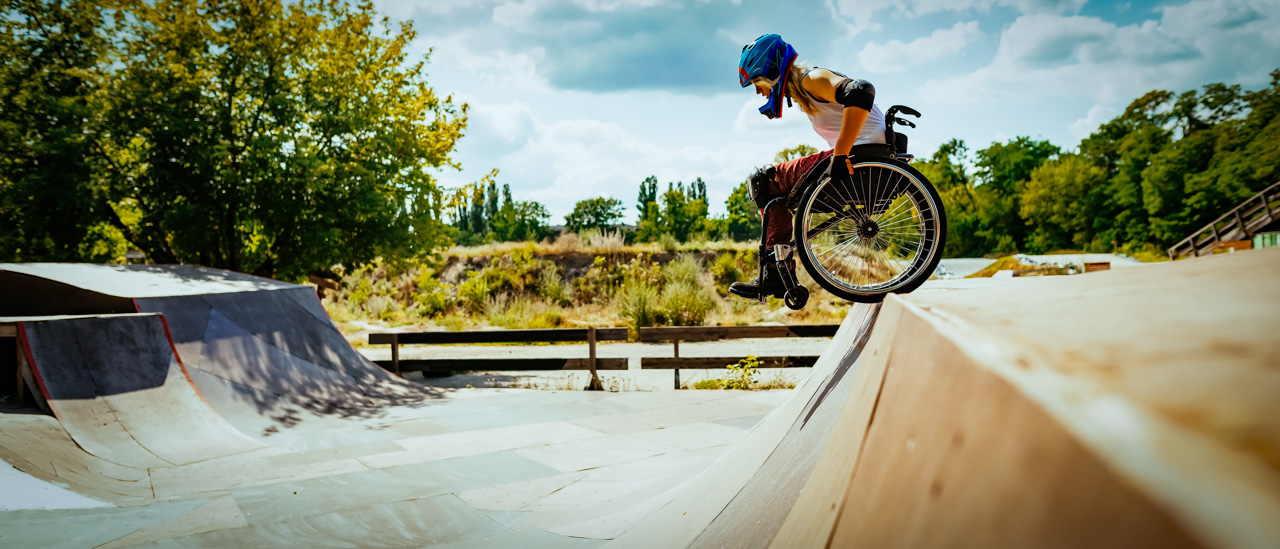

Start thinking about disability as a part of normal life and noticing where it’s elided and where it’s celebrated
Disabled people are often assumed not to exist in public space; as a result, many journalists don’t consider looking for us.
From what I’ve seen, the most common barrier to finding good disabled sources is that, frankly, most people don’t know disabled people. Or, more accurately, most people don’t know that they know us — and sometimes, they don’t know that they are us.
Given that more than one in four Canadians are disabled (see Introduction), why does this continue to happen? Now that most children with disabilities have been mainstreamed into public schools, and living in an institution is no longer a given, why is it still so difficult for disabled people to be seen as a normal part of public life?[1] I’m not sure. But I have some ideas.
It’s not that I think there is some ableist cabal plotting in a smoky back room, saying, “Now, how will we keep the disabled out of public space today?” (And note “the disabled” is not language I recommend; see Language.) But I would like to suggest to my readers that you have been encouraged to believe in a collective delusion about the way life works, one in which healthy, non-disabled people are the norm and disabled people are a small proportion of the population. That is, they are not “us,” they are somehow apart from the rest of us. Exceptions. People who do not belong in public. People who should be somewhere else — a place that has all the things disabled people need.
When disability is covered as a niche, a curiosity, a tragedy or an aberration, it is not covered in a way that reflects the truth: disability is a part of everyone’s life, including those who do not consider themselves vulnerable or identify as disabled. The things that concern disabled people are concerns for all of us. The erasure of disabled people has influenced our institutions, medical care, design choices, and the way we live and work. Medical science and the design of physical spaces have largely been constructed around the idea of a “normal” or normative body.
Journalists are mandated to ask questions. As media professionals, we can do this when it comes to our physical environment, by asking about the ways people are invited into a space, by asking who is given time to speak — and by asking who is assumed not to have anything to say.
Get to know your local disability services: transit, education, medical, recreational and so on. Check in with disability-focused non-profits. You’ll be able to find stories there.
Start paying attention to the physical accessibility of your local environment. For example, ask:
- What’s the entrance like in that restaurant, and are its washrooms accessible?
- Is there a lot of echoing or crosstalk that might make it more difficult for people who are hard of hearing to hear?
- Is there braille signage when you try to navigate a new space?
- Are there audible cross signals when you’re crossing the street?
- What is the sensory environment like? Is it loud and are the lights harsh?
- If it’s winter, are the streets and sidewalks clear of snow and ice?
Once you start noticing such things, you will automatically begin to notice more things, which will then generate yet more potential story ideas and help you build relationships with possible sources. You’ll get to know people who aren’t already in the room — or who couldn’t get in the room in the first place.
When we journalists consider a disability as part of the world, and disabled people as part of our audience, we may even discover that it is easier to find disabled people than we thought, because they are all around us. You may begin to wonder whether maybe that leg injury that makes it hard for you to climb steep stairs could be a disability. You may start thinking about how you tell everybody that you work best under pressure and need a deadline to function, and that you were one of those kids who was a pleasure to have in class, but so talkative and easily distracted. So maybe you learn a bit about attention deficit hyperactivity disorder (ADHD) and wonder, “Hey, could this apply to me?”
It’s time for us to design our coverage around the idea that disability is part of life. This will change the kind of questions you ask and the kind of stories you put out, and people will take notice. And you’ll come to realize that it’s not so hard to find disabled sources, because you already know them — you just call them your “legal expert,” or your “voice from within the Conservative party,” or “that guy who knows a lot about ecology.”
SOURCES
-
For more about the history of institutionalization, see sources such as:
Inclusion Canada et al, Truths of Institutionalization: Past and Present, https://truthsofinstitutionalization.ca/.
Jennifer Senior, “The Ones We Sent Away,” The Atlantic, August 7, 2023, https://www.theatlantic.com/magazine/archive/2023/09/disabled-children-institutionalization-history/674763/.
TVO is a registered charity #85985 0232 RR0001
Visit our other websites:
TVO.me  • TVO Today • TVO Learn • TVO ILC • TVOkids
Copyright © 2026 The Ontario Educational Communications Authority (TVO)
Terms of Use • Privacy Policy • Copyright